DRAM 2028: the shortage that is really a routing decision
Two prices for one module, a 15 to 20 percent capacity increment, and a routing decision remade monthly: which of the two markets breaks first.
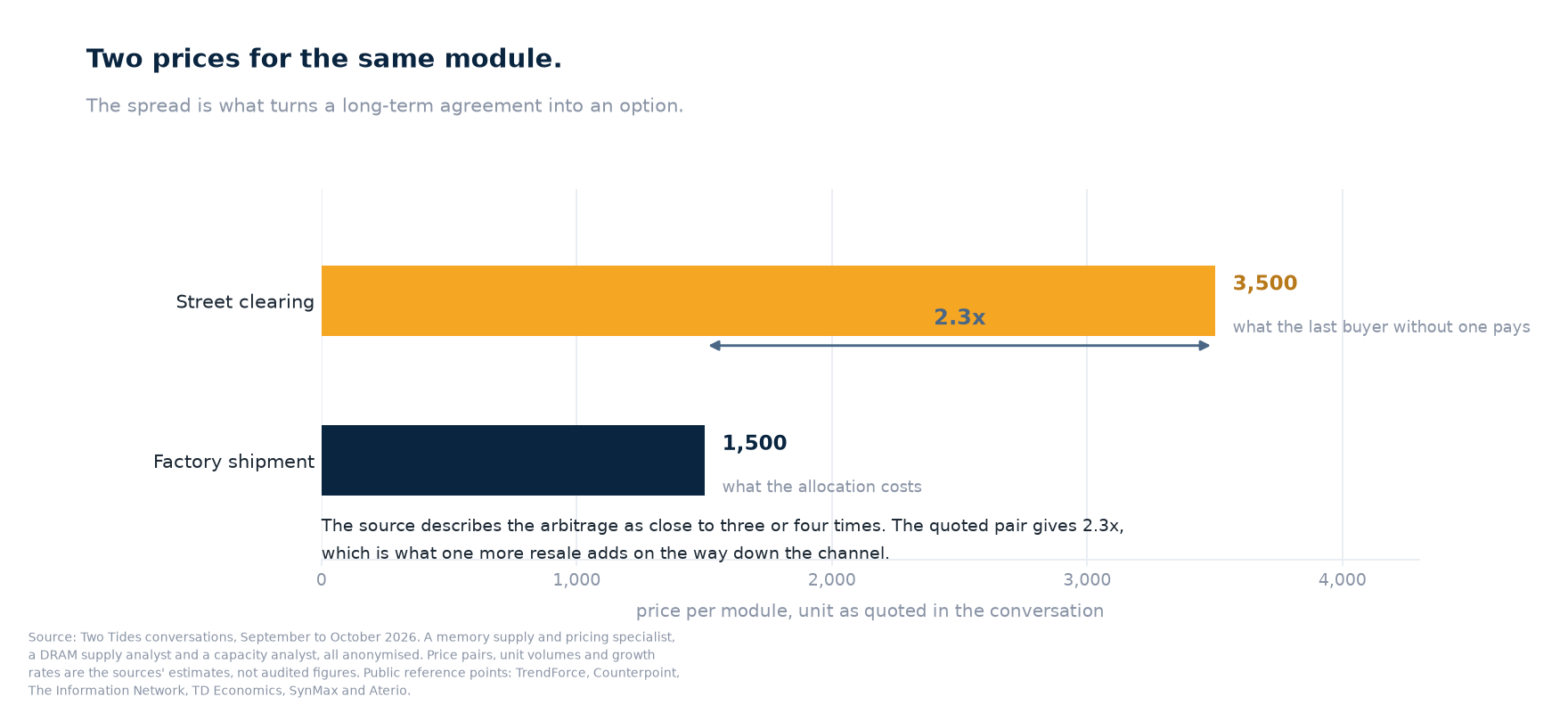
- 2.3xthe factory-to-street gap on one memory module, quoted by a single channel source as about 1,500 against about 3,500, with no unit stated
- 15 to 20 percentguided growth in industry DRAM wafer capacity for 2027, a supply-side estimate rather than a published capex plan
- 1.5 ppone industry estimate of CXMT's yearly contribution to industry bit-capacity growth, because its cell density is about half the incumbents'
- 50 to 80 percentthe share of modules stripped from newly delivered servers and resold, on the same source's unaudited estimate
Memory clears in two markets at once. Long-term agreements fix a quarterly contract price against a ceiling; buyers without an allocation pay a street price set by the last bidder. TrendForce's 30 September 2026 release guided conventional DRAM contract prices up 10 to 15 percent in the fourth quarter, while a channel specialist put the same three months at 3 to 8 percent. Only one appears in an index.
One source quotes about 1,500 from the factory and about 3,500 on the street for the same module, with no unit stated. The ratio is the finding, with the contract below clearing.
What actually arrives in 2027
The headline increment is ordinary capex. These are supply-side estimates from three anonymous conversations in September and October 2026, not audited disclosures.
| Line | Guided 2027 addition | Where the figure comes from |
|---|---|---|
| Industry DRAM wafer capacity | +15 to 20% | supply-side estimate, September 2026 |
| HBM-directed supply | +30% or more | same conversation |
| NAND, YMTC | about +20% | same conversation |
| NAND, Samsung and SK Hynix | under 10% each | same conversation |
| CXMT, Shanghai fab | 50,000 to 80,000 wafers a month across the year | DRAM supply specialist, October 2026 |
Routing matters more than the total. HBM takes two to three times the wafer area of conventional DRAM per bit, so a point moved to the stack removes more than a point from commodity supply. One analyst puts three-fifths to two-thirds of planned capacity against AI products, a posture unsigned by contract. The mix is re-planned about three months out, on a three to six month lead time.
The premium that decides the queue
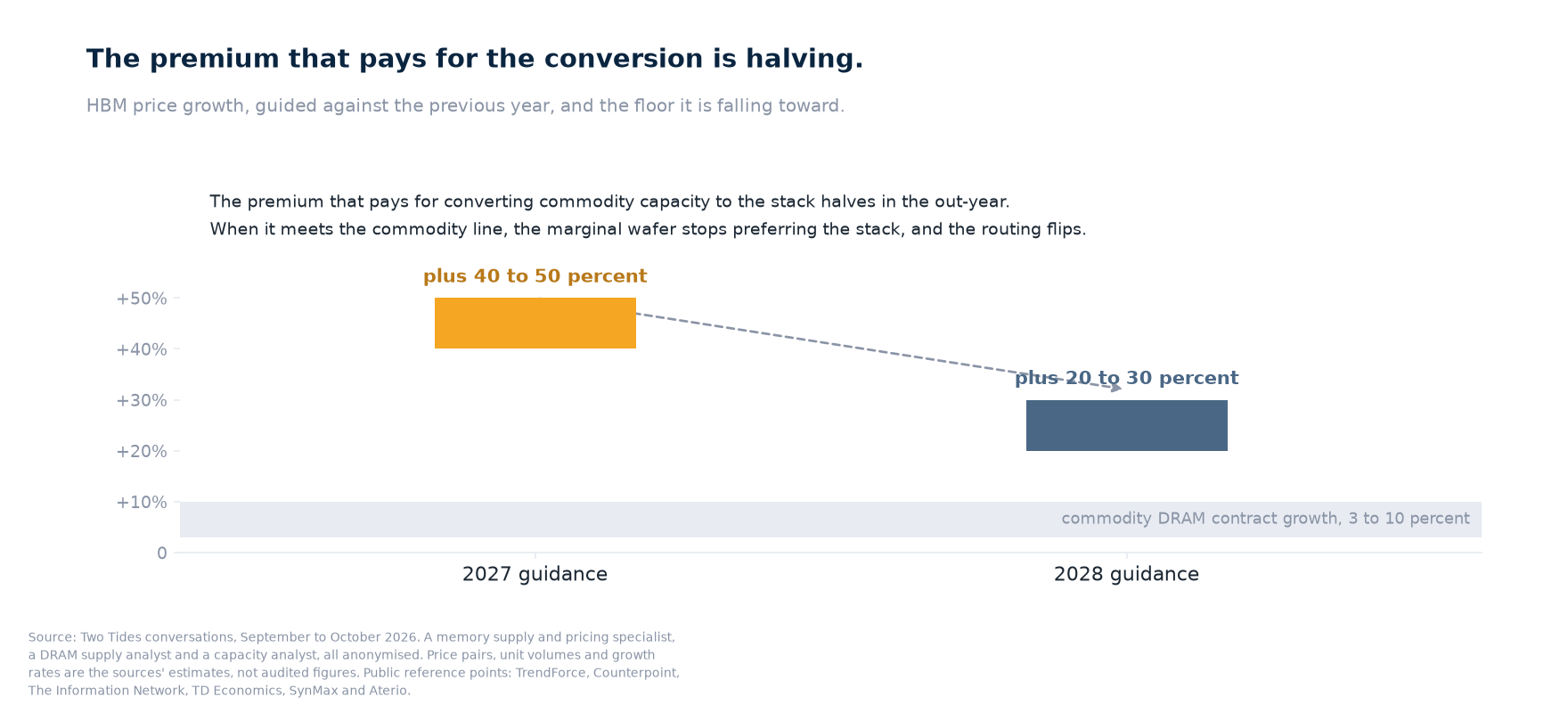
HBM prices are guided up 40 to 50 percent in 2027 and 20 to 30 percent in 2028, against commodity DRAM contract growth of 3 to 10 percent. The premium that pays for converting a wafer halves in the out-year; when it meets the return on server DRAM, the marginal wafer stops preferring the stack.
A price war in a two-price market does not begin in the index. The increment lands in the merchant segment, where the street price can halve and still sit above contract. Agreement bands cap rises but do not release volume on the way down, so contract buyers stay short while distributors, pulled modules and sites waiting on grid power sell together. The index moves last, a quarter or two after the inventory has changed hands.
The control experiment
DDR4 already settled how this market prices. The three manufacturers scheduled end-of-life, yet TrendForce recorded 8-gigabit DDR4 contract prices up 5.77 percent month on month in October 2026, and spot DDR4 rose 50 to 70 percent in one quarter earlier that year. Installed server platforms validated around DDR4 cannot re-platform to save on a component. Price follows switching cost, not production cost. One source reports that some domestic lines never stopped; public confirmation is thin, and the claim is unconfirmed by disclosure.
What would change the picture
The bull case is a demand gap: AI-related demand judged above 50 percent a year against AI-directed supply at 30 percent or more. Four signals would show the queue flipping: the factory-to-street spread, 2028 HBM guidance below 20 percent, a pause in Samsung's rising server DRAM allocation share, and DDR4 supply.
CXMT is the fastest-growing wafer base in DRAM, from roughly 320,000 wafers a month to a commonly quoted 550,000 by 2028. In bits it adds about 1.5 percentage points a year on one industry estimate, because its cell density is roughly half. Who routes them is the 2028 question.
The analysis behind these numbers runs seven sections: the two prices, the inventory that looks like demand, the DDR4 control experiment, and the routing decision that decides whether 2028 is a shortage or a price war.
Read it in Two TidesThis page is the public data companion to Tide 010 in Two Tides. The complete argument, including the two-price mechanism and the 2028 conditional, is the post in the letter.
Research, not advice. This page is research and commentary on an industry. It is not investment, legal or engineering advice, and not a recommendation to buy or sell any security. Figures are the best estimate available at the time of writing; where one rests on a single source, the text says so.
Cite this page as: Quorsio, "DRAM 2028: the shortage that is really a routing decision", November 2026, with a link to this URL. Short excerpts with attribution are welcome. Republishing the page in full, including its tables and charts, needs written permission: hello@quorsio.com.