How much revenue does one gigawatt of AI compute earn?
Everyone quotes $110 billion a year. Priced from six angles you can check, the same gigawatt earns $10–15 billion — and the gap is where the financing risk lives.
- $110Bquoted per gigawatt-year, traced to a rent estimate with its conditions removed
- $10–15Bwhat labs actually realize per gigawatt-year, cross-checked two ways
- $11.6Bwhat the owner needs to earn for a 15% return, by Goldman Sachs's arithmetic
Somewhere in a board deck near you sits a line of arithmetic that has done more to justify AI capital expenditure than any earnings report. One gigawatt of AI compute, it reads, one hundred and ten billion dollars of annual recurring revenue. Since a one-gigawatt build runs to fifty or sixty billion, the building appears to repay itself in six months, which is the kind of number that ends a budget meeting.
It is wrong by roughly a factor of three. The interesting part is not the correction — any spreadsheet can do that — but what the error reveals: a rent figure has been circulating in a revenue costume for two years, underwriting decisions worth hundreds of billions.
Where the number came from
The traceable origin is an estimate by SemiAnalysis that OpenAI and Anthropic can earn more than $100 billion a year from a gigawatt of inference sold through their APIs. The sentence carried three qualifications, each of which fell off on the way to the conference stage: it is gross lab revenue before the cost of training a single model, so the building's owner never sees it; it assumes frontier API pricing, the richest rates in the market; and it describes a ceiling case, a cluster running flat out on paid inference. Slides hold conclusions, not conditions.
Six prices for the same gigawatt
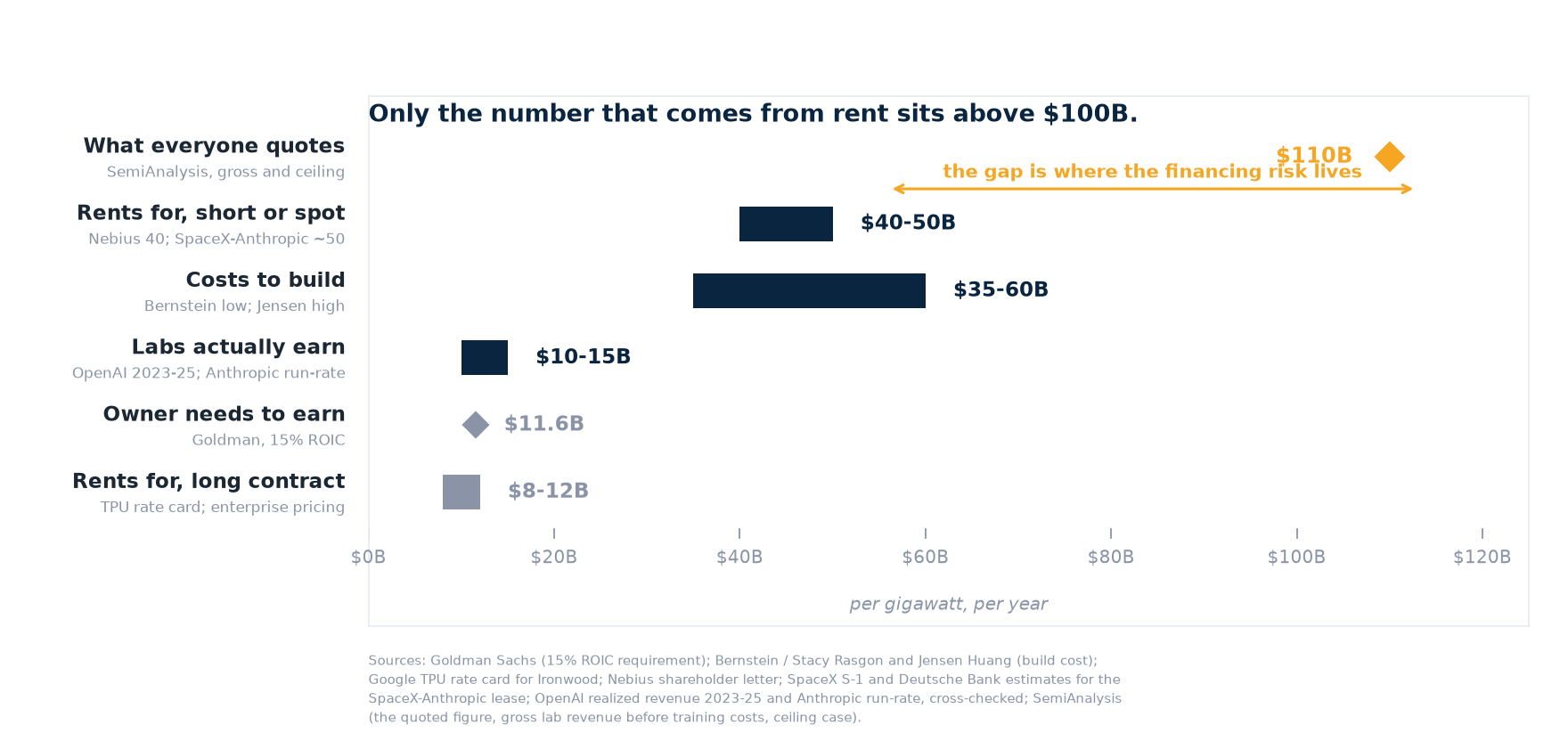
| What the gigawatt does | Per year | Source |
|---|---|---|
| What it costs to build | $35–60B | Bernstein at the low end; Jensen Huang at the high end |
| What it rents for, long contract | $8–12B | Enterprise pricing; Google TPU rate card |
| What it rents for, short or spot | $40–50B | Nebius at $40B; SpaceX–Anthropic near $50B; Deutsche Bank on Google–SpaceX at $45B |
| What its owner needs to earn | $11.6B | Goldman Sachs, 15% return on invested capital |
| What labs actually earn on it | $10–15B | OpenAI realized 2023–25; Anthropic run-rate cross-check |
| What everyone quotes | over $100B | SemiAnalysis, gross revenue and ceiling case |
Google publishes the only honest rate card in this market. Ironwood, its current flagship TPU, lists at $12 per chip-hour on demand, $8.40 on a one-year commitment and $5.40 on three years — identical silicon, a 55% discount for time. At the other end, Nebius reports about $40 billion per gigawatt-year on short contracts, and the SpaceX–Anthropic lease annualizes to roughly $50 billion.
From watts to revenue
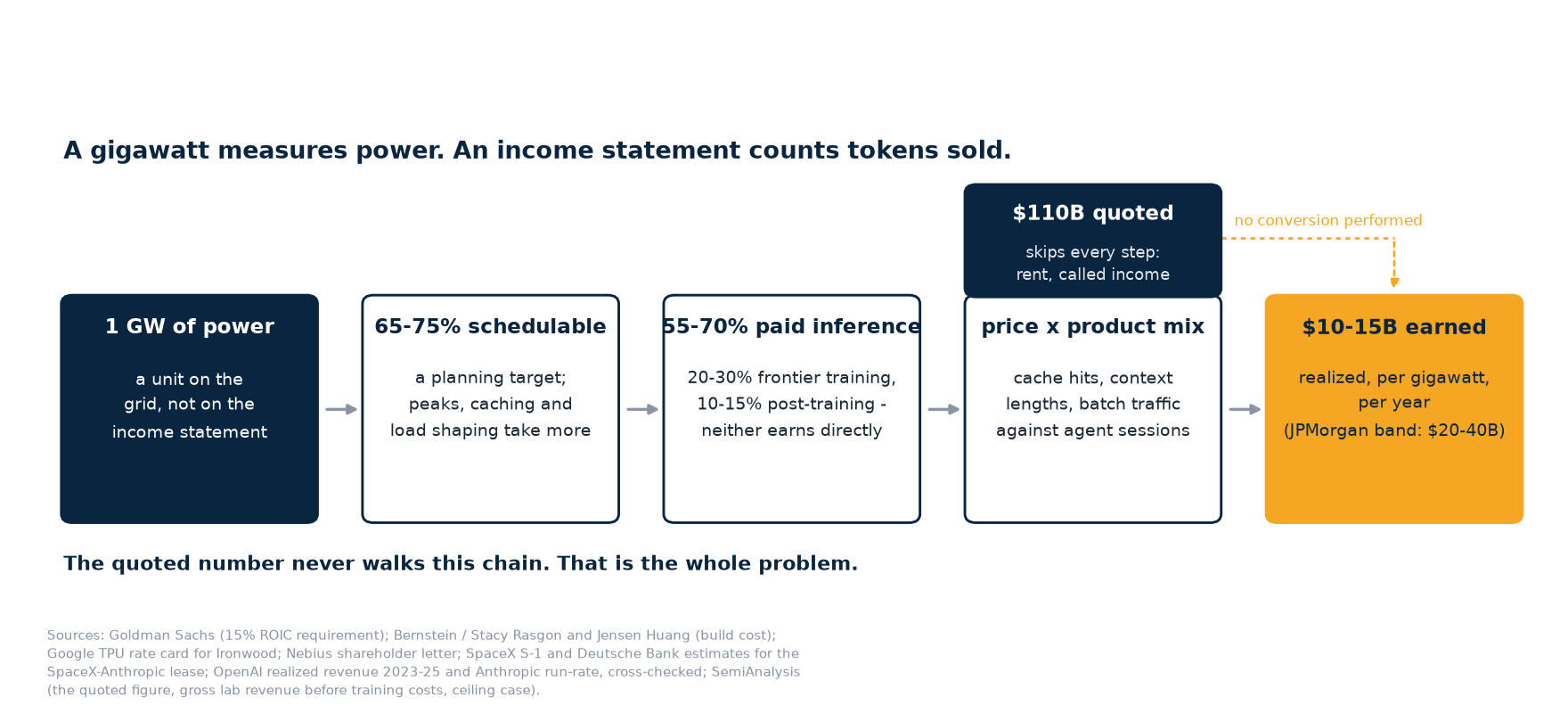
A gigawatt measures power; an income statement counts tokens sold, at what price, with what share of the machine doing paid work. Operators plan around 65–75% schedulable utilization, then the workload mix takes its cut: 20–30% of a frontier fleet runs training, which earns nothing directly. Multiply what remains by the price of a token and JPMorgan's framework lands at $20–40 billion a year, against about $10 billion realized in 2025.
The cross-check the company ran on itself
In April 2026 Anthropic announced a run-rate above $30 billion, up from roughly $9 billion at the end of 2025. Assign all of it to inference, which flatters the result, and divide by the compute the company could actually serve: the answer lands between $10 and $15 billion per gigawatt, seven to twenty times below the number in circulation.
The company's own filings agree with the smaller figure. A prospectus Reuters reviewed in September lists $518 billion of commitments over a decade, about 80% of them non-cancellable or payable regardless of usage, against 2025 revenue of $4.6 billion. If a gigawatt earned $110 billion, a company holding eleven of them would treat those covenants as a rounding error, and the lawyers would not have spent the pages.
The ten-minute check
Before accepting any per-gigawatt revenue claim, three questions separate the defensible from the decorative: what fraction of the power runs paid inference, at what realized load, and what a token sells for after discounts. The public versions of those questions are cheaper to answer than most decks assume — build cost, rent by contract length, and the buyer's own run-rate.
The full issue walks the whole ladder, including the lease where the top of the market prices urgency rather than income — and why that premium has to decay.
Read it in Two TidesThis page is the public data companion to Two Tides Issue 006. The complete argument, including the contract structure and the 2027–28 oversupply case, is in the letter.
Research, not advice. This page is research and commentary on an industry. It is not investment, legal or engineering advice, and not a recommendation to buy or sell any security. Figures are the best estimate available at the time of writing; where one rests on a single source, the text says so.
Cite this page as: Quorsio, "How much revenue does one gigawatt of AI compute earn?", November 2026, with a link to this URL. Short excerpts with attribution are welcome. Republishing the page in full, including its tables and charts, needs written permission: hello@quorsio.com.