Data centre water: 0.12 to 1.8 litres per kilowatt-hour, and the account nobody publishes
Two camps, two denominators: the fence line the stopped camp engineers to zero, and the grid account the kept camp argues with.
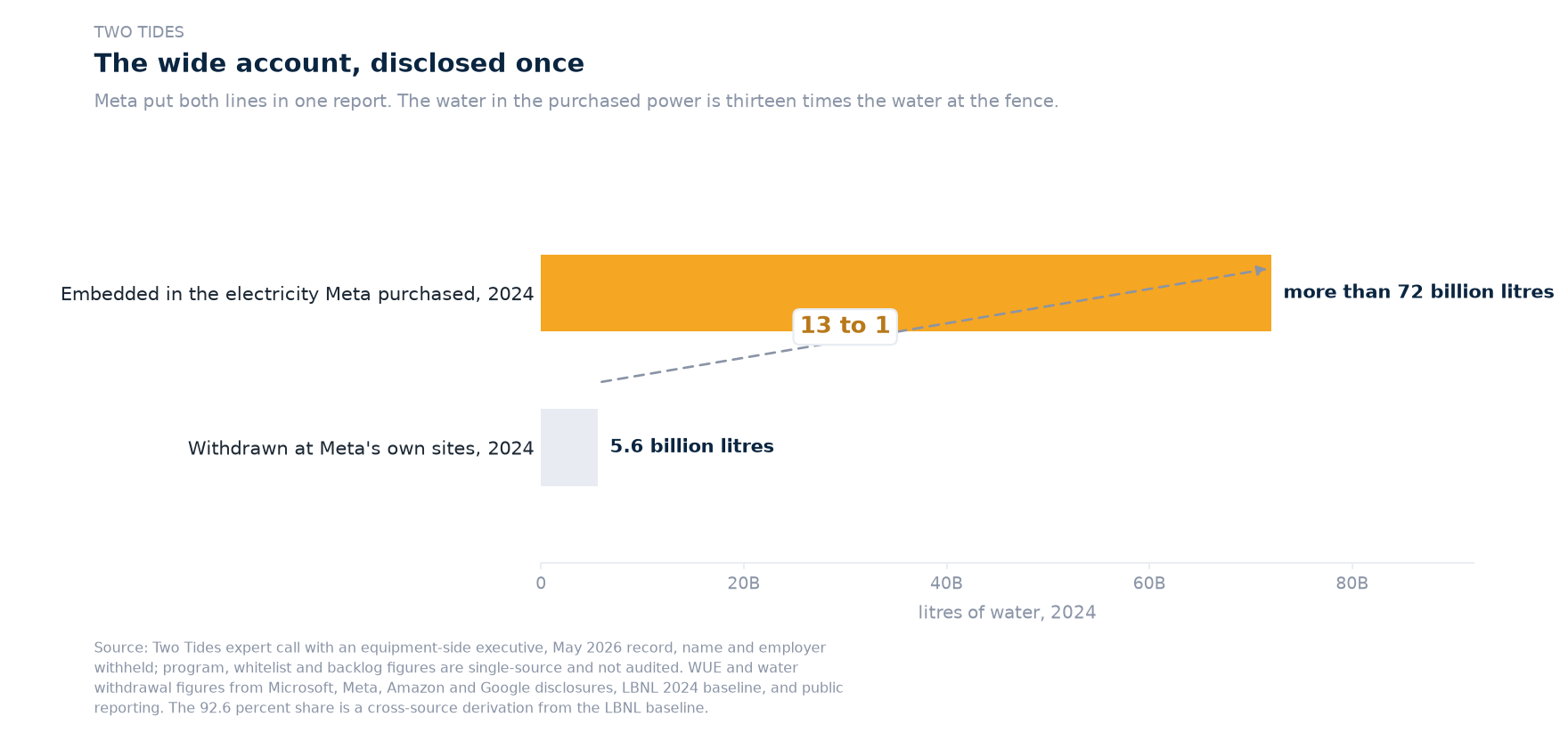
- 13 to 1Meta's 2024 water account: 5.6 billion litres drawn at its own sites against more than 72 billion embedded in the electricity it purchased
- 92.6 percentthe share of American data centre water that sits in the power grid, invisible at the fence line, on a cross-source analysis of the LBNL baseline
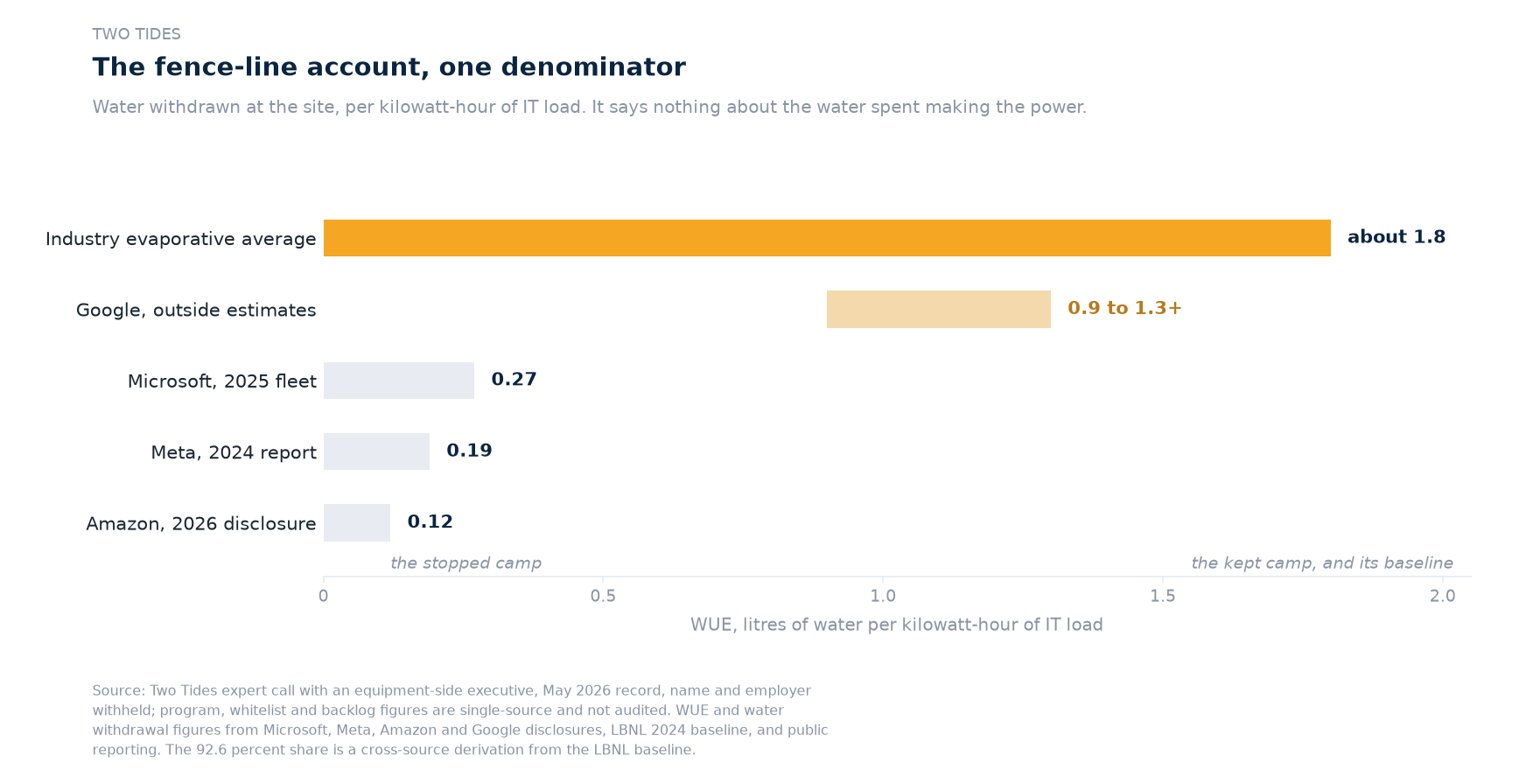
- 0.12 to 1.8fence-line WUE in litres per kilowatt-hour: Amazon, Meta and Microsoft at the low end, the evaporative industry average near the top
Four hyperscalers have split into two camps that no longer build the same machine. Microsoft and Meta have stopped evaporating water for cooling: Microsoft with a closed-loop, direct-to-chip design announced in 2024 that covers about ninety percent of its 2025 fleet, its average WUE down from 2.3 to 0.27 litres per kilowatt-hour, and Meta with liquid loops and dry coolers that in normal operation consume almost nothing, reporting 0.19. Amazon reports 0.12. Google and Amazon still build evaporative systems where the climate allows it, and they defend the choice with the account nobody publishes as a headline: evaporating at the site uses less electricity, and the electricity is where the larger water account lives.
The wide account inverts the ranking. Meta disclosed both lines in one report: 5.6 billion litres withdrawn at its sites in 2024, above 72 billion embedded in purchased power, thirteen to one. The LBNL baseline counts 17.4 billion gallons of direct cooling water for American data centres in 2023 against 211 billion embedded in their electricity, and a cross-source analysis of that baseline puts 92.6 percent of the account in the grid. Google's own disclosure shows the cost of its bet: site water withdrawal rose about 27 percent in 2024, in line with its power demand. Generation water intensity decides the wide account, coal near 70 litres per kilowatt-hour against 10 to 12 for gas combined cycle and near zero for renewables, so the same building gets lighter as the grid gets cleaner, with no design change.
What the order book shows
The equipment side sees the split as lead times. A water-wall supplier booked into 2027 cannot meet Google's delivery dates, which opened the primary side to new entrants quoting the full stack: CDU, manifold and piping on the secondary, dry coolers, chillers, cooling towers and water walls on the primary. A North American program won in May 2026 for about 2.8 billion dollars was divided into three independent packages, and its chiller package, about 560 million of the total, buys evaporative-cooled water hosts: the camp that talks about quitting evaporation is still buying the machinery that evaporates, one building at a time. The single-source figures in this paragraph are a practitioner's estimates, not audited counts.
The value structure explains the strategy behind those orders. Pumps and valves inside a CDU sit on a customer-controlled whitelist of essentially all foreign brands, near 85 percent of unit cost, which caps delivery and margin for the integrator. On the primary-side product lines, roughly half to sixty percent of value can be manufactured in-house with no whitelist in front of it, which is why every supplier enters through the CDU and builds the business on the dry side.
The call behind these numbers runs eleven questions: why anyone still evaporates, what the water actually touches, what zero means in equipment, and where the value sits in the water chain.
Read it in Two TidesThis page is the public data companion to The Call 05 in Two Tides. The conversation itself, edited and with the source's own corrections left in, is the post in the letter.
Research, not advice. This page is research and commentary on an industry. It is not investment, legal or engineering advice, and not a recommendation to buy or sell any security. Figures are the best estimate available at the time of writing; where one rests on a single source, the text says so.
Cite this page as: Quorsio, "Data centre water: 0.12 to 1.8 litres per kilowatt-hour, and the account nobody publishes", November 2026, with a link to this URL. Short excerpts with attribution are welcome. Republishing the page in full, including its tables and charts, needs written permission: hello@quorsio.com.