Ulanqab's data center power: 2 GW live and no grid bays left to allocate
Twenty-six developers, 20,000 mu of land and a 12 to 13 GW envelope. What is missing is not electricity, and the flagship green-power workaround breaks at 70 km.
- 2 GWenergized at China's biggest data center cluster, the low end of a 2–3 GW band
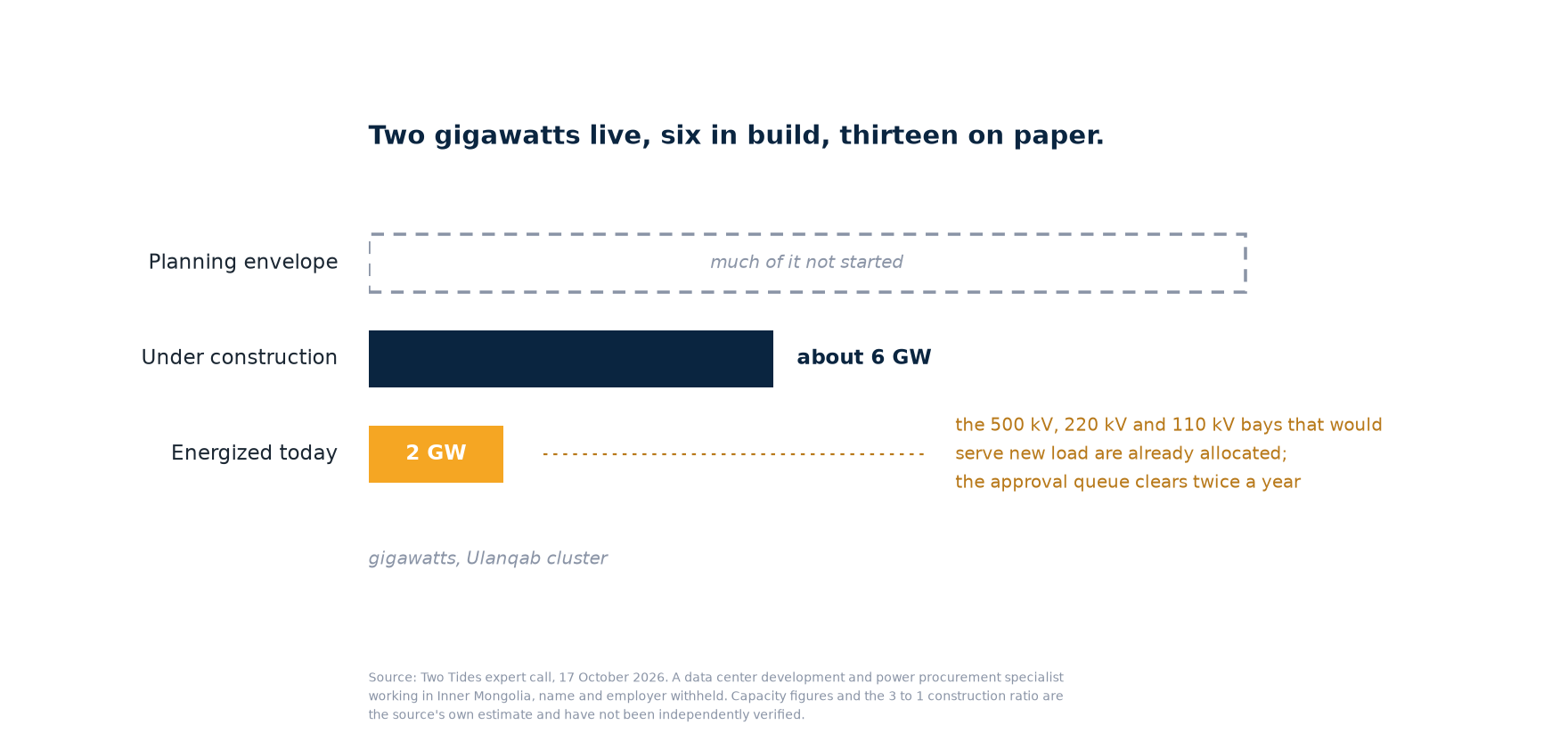
- 3:1construction to live load, with 12–13 GW of planning envelope behind it
- 190 vs 70 kmthe flagship green-power pairing sits at roughly 190 km; the modelled break-even for that scheme is about 70 km
Ulanqab, on the grassland north of Hohhot in Inner Mongolia, is where Chinese AI data center capacity gets built when nobody is watching. Around 26 developers hold more than 20,000 mu of land there, roughly 1,300 hectares, and the cluster has crossed 2 GW of energized capacity against a planning envelope of 12 to 13 GW. About three times the live load is under construction. The constraint is not electricity. Inner Mongolia has coal, wind and solar in surplus, and a single site can concentrate tens of gigawatts of load across a few dozen square kilometers. The constraint is the thing that connects the two.
Where the queue actually sits
The 500 kV, 220 kV and 110 kV bays that would have to serve new load are essentially allocated by existing projects. Everything behind them now runs through a national approval process that opens twice a year, in February and August. The green-power rule closes the obvious escape route: Inner Mongolia requires 80% renewable supply and gigawatt-scale projects are targeting 100% by 2030, while new energy construction is confined to 13 or 14 designated zones that sit far from the data center clusters.
The distance arithmetic
In the flagship pairing, two 120 MW data center buildings were each matched to a 200 MW wind farm. The farms sit roughly 190 km from the load, and the modelled break-even for that source-grid-load storage scheme is about 70 km. Green direct-connect power prices near 0.25 yuan per kWh all-in against a conventional Ulanqab tariff of 0.32 to 0.36, so the saving is real; the transmission distance is what stopped the project.
What would change the picture
Three observations would move this reading. Watch the February and August approval batches: if the next round clears materially more bays than the last, the queue is loosening and the 3:1 ratio starts to close. Watch whether any completed shell stays dark through a full quarter, which is the visible signature of a power problem rather than a demand problem. And watch the rack power numbers, because a pod that drew 15 kW in 2024 draws 30 to 40 now and liquid-cooled racks pass 100 kW, so a fixed megawatt allocation feeds fewer accelerators every year it sits unused.
| Item | Figure | Note |
|---|---|---|
| Energized capacity | 2–3 GW | closer to the low end |
| Volume in build | ~6 GW | implied by the ~3:1 ratio |
| Planning envelope | 12–13 GW | includes unstarted parcels |
| Developers at scale | ~26 | excludes small projects |
| Green power floor | 80% | Inner Mongolia, mandatory; 100% by 2030 for GW-scale |
| Green direct-connect, all-in | ~0.25 yuan/kWh | conventional tariff 0.32–0.36 |
| Pairing distance vs break-even | ~190 km / ~70 km | flagship project against modelled break-even |
The call itself runs fourteen questions: the bay queue, the 80% green-power floor, the 190 km pairing that missed its own break-even by 120 km, and the two questions the source would not answer.
Read it in Two TidesThis page is the public data companion to The Call 02 in Two Tides. The conversation itself, edited and with the source's own corrections left in, is the post in the letter.
Research, not advice. This page is research and commentary on an industry. It is not investment, legal or engineering advice, and not a recommendation to buy or sell any security. Figures are the best estimate available at the time of writing; where one rests on a single source, the text says so.
Cite this page as: Quorsio, "Ulanqab's data center power: 2 GW live and no grid bays left to allocate", November 2026, with a link to this URL. Short excerpts with attribution are welcome. Republishing the page in full, including its tables and charts, needs written permission: hello@quorsio.com.