Liquid cooling: from 30 kW to 218 kW a rack, and the bill inside the loop
The constraint is not how much heat the loop carries. It is how much room the loop needs to carry it, and a floor drawn for a tenth of the load.
- 30 → 218 kWthe hall a hyperscaler finished in 2023 against the rack that ships for Vera Rubin: 7.3 times the load the room was built for
- $60,600the liquid loop inside one rack, before the CDU: 36 cold plates, 2 manifold pipes, 180 pairs of quick disconnects
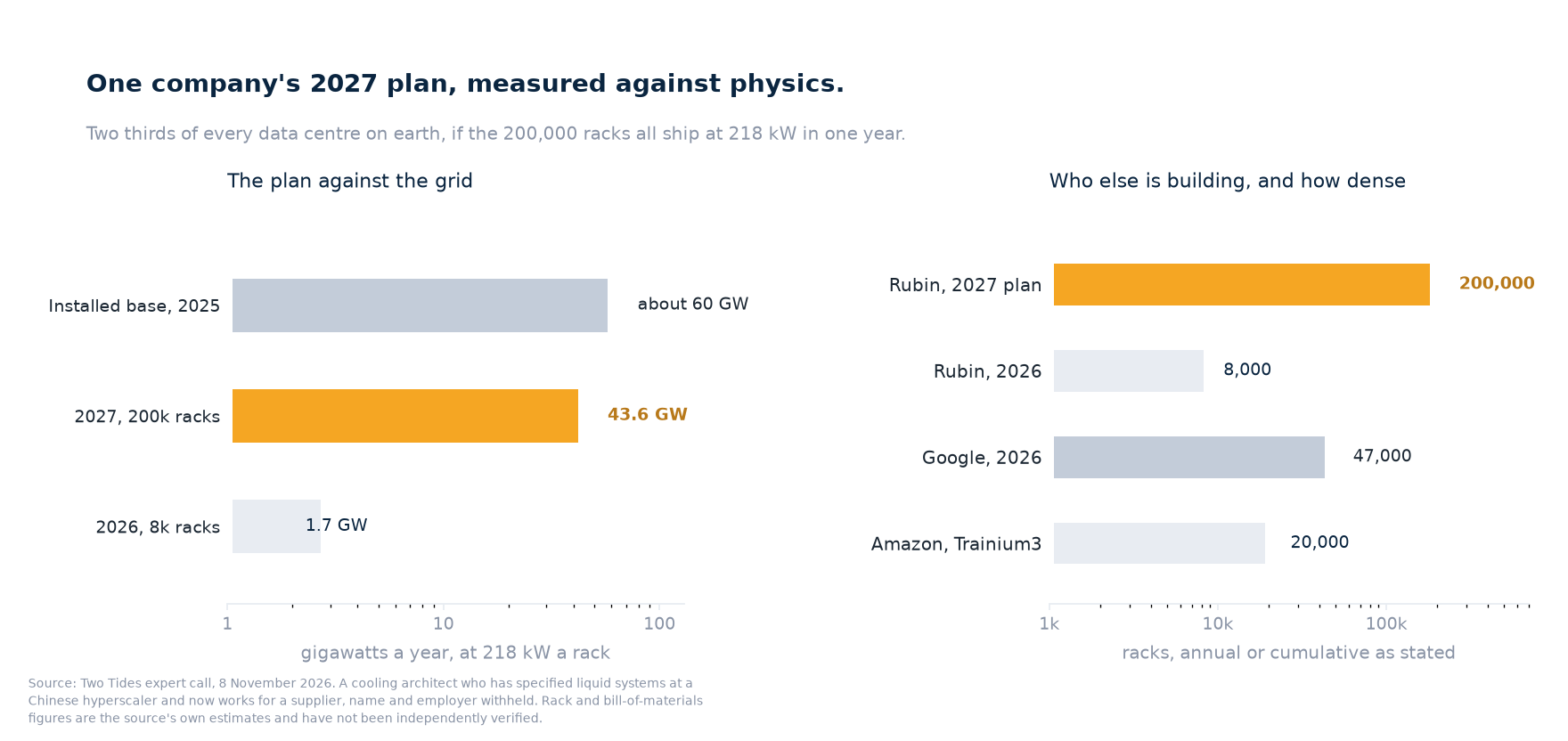
- 43.6 vs 60 GW200,000 racks at 218 kW for 2027, set against roughly the installed capacity of every data centre on earth
The public reference for the Vera Rubin rack sits between 180 and 230 kW, and the figure a cooling architect gives for what actually ships is 218, up from 132 to 142 on GB200. The gap is why the cold plate changed: micro-channels at 70 micrometres against 700 to 800 before, and a two-piece plate that is bonded and welded rather than brazed. The harder constraint, though, is not heat. It is room. A liquid-to-liquid CDU sized for eight VR200 racks runs past 2 MW, an in-row unit cannot pass about 300 kW without reaching 1.2 metres of width, and an in-rack unit at 300 kW costs 2U of the front face the rack was bought for.
The ladder
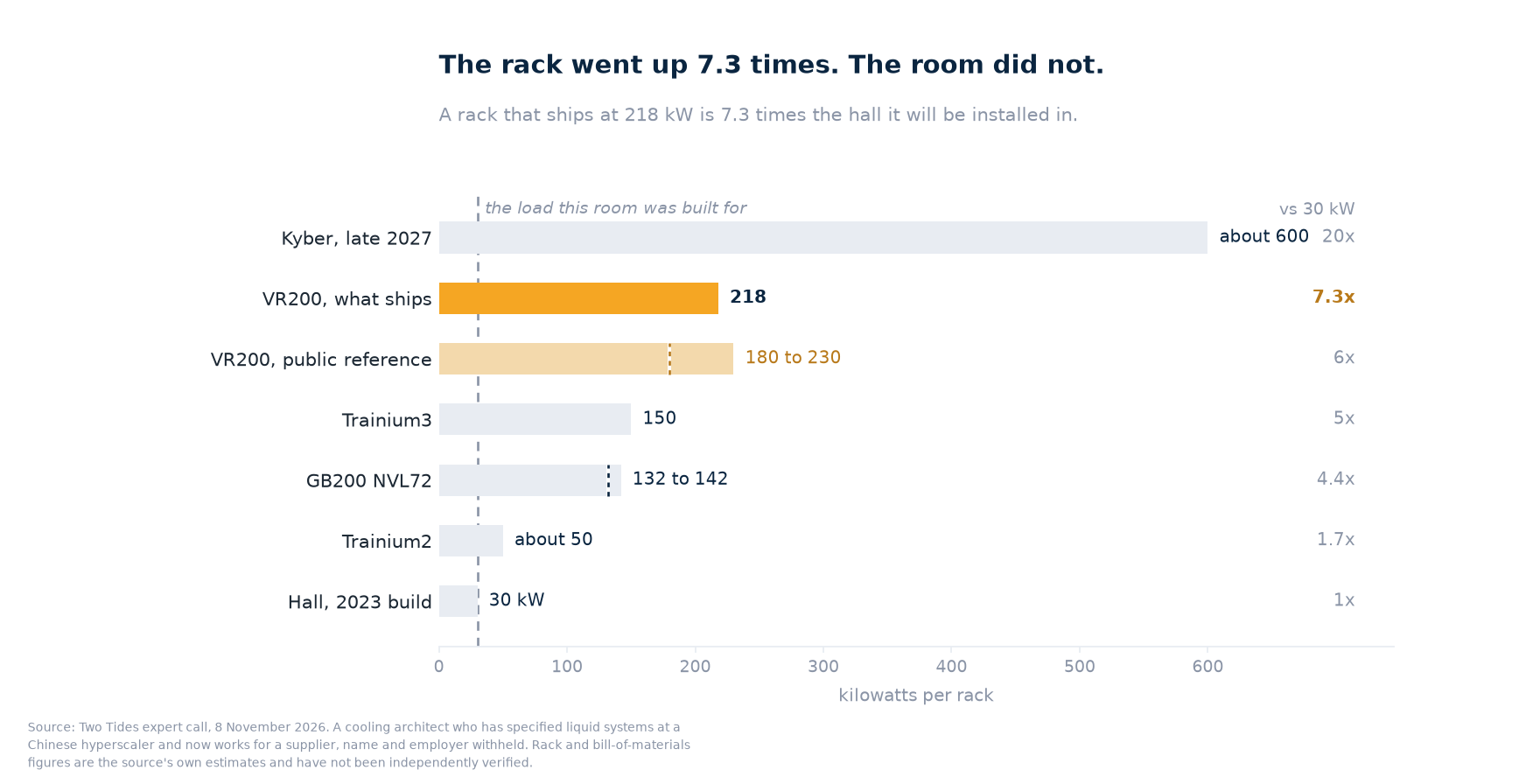
Seven racks, one line. Every figure in the current buildout is measured against the same room: the 30 kW hall a hyperscaler finished three years ago. Kyber, drawn for late 2027, is twenty times that room.
| Rack | Power | Note |
|---|---|---|
| Hall, 2023 build | 30 kW | the load the room was specified for |
| Trainium2 | ~50 kW | 500 kW CDU serves ten racks |
| GB200 NVL72 | 132–142 kW | CDU ~1.3 MW for eight racks |
| Trainium3 | 150 kW | 20,000 racks planned, mostly after Q3 2027 |
| VR200, public reference | 180–230 kW | trade press and vendor reference designs |
| VR200, what ships | 218 kW | source's delivery figure; CDU 2.3–2.6 MW |
| Kyber, late 2027 | ~600 kW | design target, 20× the 2023 room |
The bill inside one rack
The loop is priced in parts nobody forecasts. Thirty-six cold plates land at about $1,000 each once the inner manifold is spread across the pair it serves, the two stainless manifold pipes behind the rack are $8,500 each, and 180 pairs of quick disconnects add roughly $7,600. That is $60,600 a rack before the CDU, and the CDU itself quotes $350,000 to $380,000 in the 2.3 to 2.6 MW class. At the source's 200,000-rack plan the loop alone is a $12 billion line item a year. None of it appears in an accelerator forecast, and all of it scales with the rack count alone. An existing floor without a secondary loop stays capped near 40 to 60 kW a rack on air-side measures; beyond that the building gets rebuilt, not upgraded.
What would change the picture
Watch whether the 8,000 racks targeted for 2026 actually land, because every slip propagates into the 200,000 figure behind it. Watch how the 200,000 is counted: at 218 kW a single-year plan is 43.6 GW, two thirds of the installed base, so a cumulative reading across generations is the only one that survives arithmetic. And watch the power shelf, which moves from 5.5 kW modules to 19 kW in the same cycle as the cooling redesign, because cooling and power being new together is what makes the test-coverage gap expensive.
The call itself runs twelve questions: what changed between GB200 and VR200, why the cold plate changed, what the loop inside one rack costs, and the 200,000-rack plan measured against the grid.
Read it in Two TidesThis page is the public data companion to The Call 04 in Two Tides. The conversation itself, edited and with the source's own corrections left in, is the post in the letter.
Research, not advice. This page is research and commentary on an industry. It is not investment, legal or engineering advice, and not a recommendation to buy or sell any security. Figures are the best estimate available at the time of writing; where one rests on a single source, the text says so.
Cite this page as: Quorsio, "Liquid cooling: from 30 kW to 218 kW a rack, and the bill inside the loop", November 2026, with a link to this URL. Short excerpts with attribution are welcome. Republishing the page in full, including its tables and charts, needs written permission: hello@quorsio.com.